
New HARVER DM300x2 pitting equipment




≈ US$6,721
 Uzhgorod
If you decide to buy equipment at a low price, make sure that you communicate with the real seller. Find out as much information about the owner of the equipment as possible. One way of cheating is to represent yourself as a real company. In case of suspicion, inform us about this for additional control, through the feedback form.
Before you decide to make a purchase, carefully review several sales offers to understand the average cost of your chosen equipment. If the price of the offer you like is much lower than similar offers, think about it. A significant price difference may indicate hidden defects or an attempt by the seller to commit fraudulent acts.
Do not buy products which price is too different from the average price for similar equipment.
Do not give consent to dubious pledges and prepaid goods. In case of doubt, do not be afraid to clarify details, ask for additional photographs and documents for equipment, check the authenticity of documents, ask questions.
The most common type of fraud. Unfair sellers may request a certain amount of advance payment to “book” your right to purchase equipment. Thus, fraudsters can collect a large amount and disappear, no longer get in touch.
- Transfer of prepayment to the card
- Do not make an advance payment without paperwork confirming the process of transferring money, if during the communication the seller is in doubt.
- Transfer to the “Trustee” account
- Such a request should be alarming, most likely you are communicating with a fraudster.
- Transfer to a company account with a similar name
- Be careful, fraudsters may disguise themselves as well-known companies, making minor changes to the name. Do not transfer funds if the company name is in doubt.
- Substitution of own details in the invoice of a real company
- Before making a transfer, make sure that the specified details are correct, and whether they relate to the specified company.
Seller's contacts

 +380 95 337...
Show
+380 95 337 6425
+380 99 717...
Show
+380 99 717 4185
+380 95 337...
Show
+380 95 337 6425
+380 99 717...
Show
+380 99 717 4185


 Germany, Enger

 Ukraine, Uzhhorod
 Ukraine, Uzhhorod

 Ukraine, Uzhhorod




 Spain
Spain


 Germany, Enger


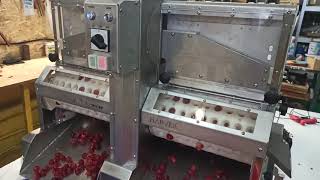
The machine is almost entirely made of food grade stainless steel. AISI304, as well as polyacetal and duralumin. Its structure complies with all applicable safety and sanitary standards and is suitable for use in food processing plants and workshops. The machine is disassembled into replaceable units for further washing and maintenance.
Features:
CE certificate;
the machine works with both small cherries and large cherry and sweet cherry fruits due to interchangeable drums;
fruit diameter - from 18 to 28 mm;
high productivity: 18 fruits are removed in one stroke of the knives, 72 strokes per minute;
1260 pitted fruits per minute;
new fruit is fed into the holes by gravity under the control of the operator;
it is possible to work with cherries after freezing. The temperature of the cherries should be: - 6°C to -8°C;
a pneumatic aspiration system is installed to remove crushed cherry parts that do not come out of the holes on their own. A pneumatic solenoid valve opens every time the drum stops and cleans a number of holes before moving it to the loading position (an air compressor is required for this);
water supply system to the stone receiver, which allows adding water for better passage of the seeds through the screw (when they are viscous due to sugar content, or when working with frozen cherries);
easy cleaning and maintenance;
significant savings in time and operating costs;
the relevant parts can be easily removed and cleaned;
minimum payback period due to high performance and low cost compared to other similar machines.
The HARVER DM300x2 is an industrial-type machine for use in confectionery and bakery shops, as well as small fruit freezing or dried fruit production facilities.
How it works:
The cherries are loaded by the operator or conveyor into the receiving bin and roll into the openings of the drums, which rotate 12 steps per complete revolution. The cherries that fall into the appropriate holes are delivered to the processing area, where sharp specially shaped plungers penetrate the centre of the fruit and remove the pit, directing it into a hole with a rubber cuff. The seeds fall into a stone collector with a screw, which removes them from the working area. The plungers return to their original position, the drum is rotated to the next steps and the pitted cherries fall out on the other side of the machine, falling into a storage container set by the operator.